Capsule Wardrobe Planner
Plan a small wardrobe where everything mixes and matches. Choose your everyday, a capsule size and two base colors plus one accent, and you get a clear checklist, tops, bottoms, layers, shoes, and the number of outfits it all adds up to. Free, no signup.
“A full closet and still nothing to wear.”
Good to know
The essentials on the method, the self-check and the most common questions.
What a capsule wardrobe is, and what the planner does+
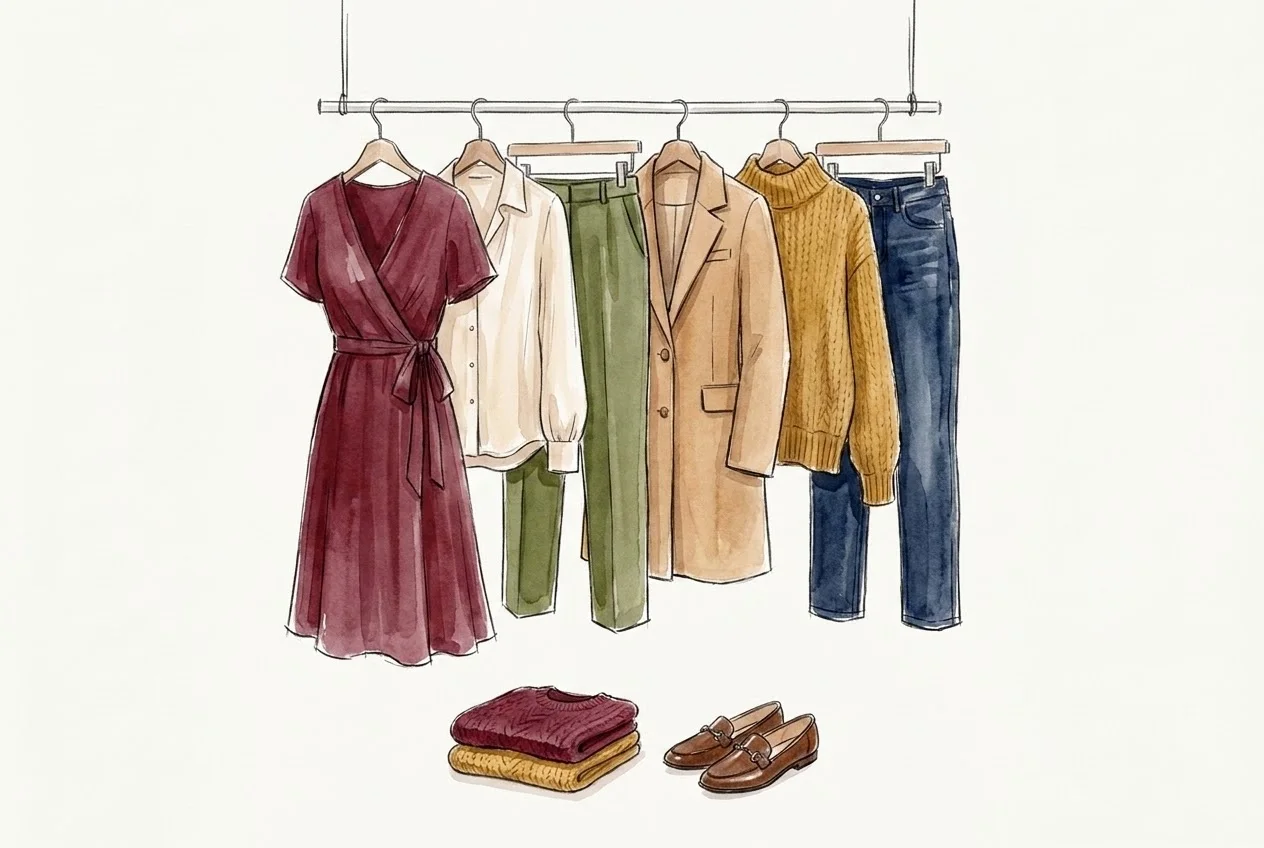
A capsule wardrobe is a small, deliberate set of clothes built around one shared color story, so that almost any top works with almost any bottom. Instead of owning a closet full of pieces that only work with one specific outfit, you own fewer pieces that each pull double or triple duty. The result looks bigger than it is, because the combinations multiply even though the item count stays low.
The Capsule Wardrobe Planner works the other way round, from the plan to the closet. You pick your everyday life (casual, mixed or work), a capsule size of 12, 20, 30 or 40 pieces and two neutrals plus one accent color. You get a checklist with how many tops, bottoms, dresses, layers, shoes and bags to aim for, the number of outfits that split makes, and a small palette built from your three colors. Hold that list next to your closet and you see where you already have enough and which category is still thin.
How many pieces, and how to split them+
There is no single correct capsule size. What matters is the split between categories, not the total. A small capsule of 12 pieces and a fuller one of 30 pieces follow the same logic, just scaled up. Tops usually make up the largest share, since you change them most often, followed by bottoms and skirts, then a smaller number of dresses, layers, shoes and bags.
| Category | 12 pieces | 20 pieces | 30 pieces |
|---|---|---|---|
| Tops | 4 | 6 | 9 |
| Bottoms & skirts | 3 | 5 | 7 |
| Dresses | 1 | 2 | 3 |
| Layers (jackets, cardigans) | 2 | 3 | 5 |
| Shoes | 1 | 2 | 3 |
| Bags | 1 | 2 | 3 |
Use the split as a starting ratio, not a rulebook. If you live somewhere warm, layers shrink and tops grow. If you wear dresses daily, that row grows and bottoms shrink. In the planner you set this through your everyday life, casual, mixed or work, and the split shifts with it. The ratio just gives you a sane place to start.
The color formula behind the math+
The multiplication only works if the pieces share colors. The simplest version is two neutrals plus one accent, for example navy and cream as your neutrals, with a rust or olive accent that shows up in a few pieces. Every neutral top works with every neutral bottom by default, and the accent pieces slot in wherever you want a bit of contrast. This is the same thinking behind choosing a personal color palette or working out your color type and season, you are picking colors that suit you and each other, then buying inside that story instead of chasing whatever looks good on its own in the shop.
The number of outfits follows a simple rule, tops multiplied by bottoms, plus dresses. Six tops and five bottoms already give you 30 outfits before a single dress or layer joins in. Add three dresses and you are at 33, add a couple of layers that can go over half the tops and the real number climbs higher still. Nineteen pieces built this way easily outperform forty pieces bought in ten unrelated colors.
Common mistakes when building a capsule+
- Too many accent colors. One or two accents keep the math working. Five accent colors mean five small, separate outfit families instead of one flexible wardrobe.
- Buying pieces that only work with one outfit. A loud print or an unusual cut can be lovely, but if it only pairs with one top or one pair of shoes, it is not really part of the capsule, it is a guest.
- Chasing trend pieces instead of a base. A capsule needs a stable core of basics first. Trend pieces are fine as the accent layer on top, not as the foundation underneath it.
- Forgetting the neutrals. It is tempting to buy the exciting piece and skip the plain trousers or the simple white top, but the neutrals are what make everything else combinable. Without them, the accent pieces have nothing to pair with.
How to use your result, step by step+
Start with the neutrals. Fill the biggest categories, tops and bottoms, with your two neutral colors before you buy anything in the accent color. That way every early purchase already works with everything else you own.
Add the accent color next, in small doses, a top, a bag, maybe one dress. Then pick one metal tone for jewellery and hardware and stick to it, so belts, bag straps and jewellery never fight each other. Once the base and accent are in place, put your checklist next to your closet. Where you own fewer pieces than the list suggests, often a layer or a second pair of shoes, that is your gap. Shop it specifically instead of browsing and hoping something useful turns up. A capsule built in this order rarely needs a rework later, you are just topping up a system that already works.
FAQ
What is a capsule wardrobe?
A small set of clothes in colors that all work together, so a few pieces make many outfits. This planner builds the checklist for you.
How many pieces should a capsule have?
There is no fixed number. Many people start around 12 to 30 pieces per season. Pick the size that fits your life, the planner splits it into tops, bottoms, layers and shoes.
Is the capsule wardrobe planner free?
Yes, completely free and no signup. Your result stays in your browser.