Face Shape Guide
Find your face shape in four quick questions and get the haircuts and glasses frames that suit it best, whether you are oval, round, square, heart or long.
Which hair and glasses suit my face shape?
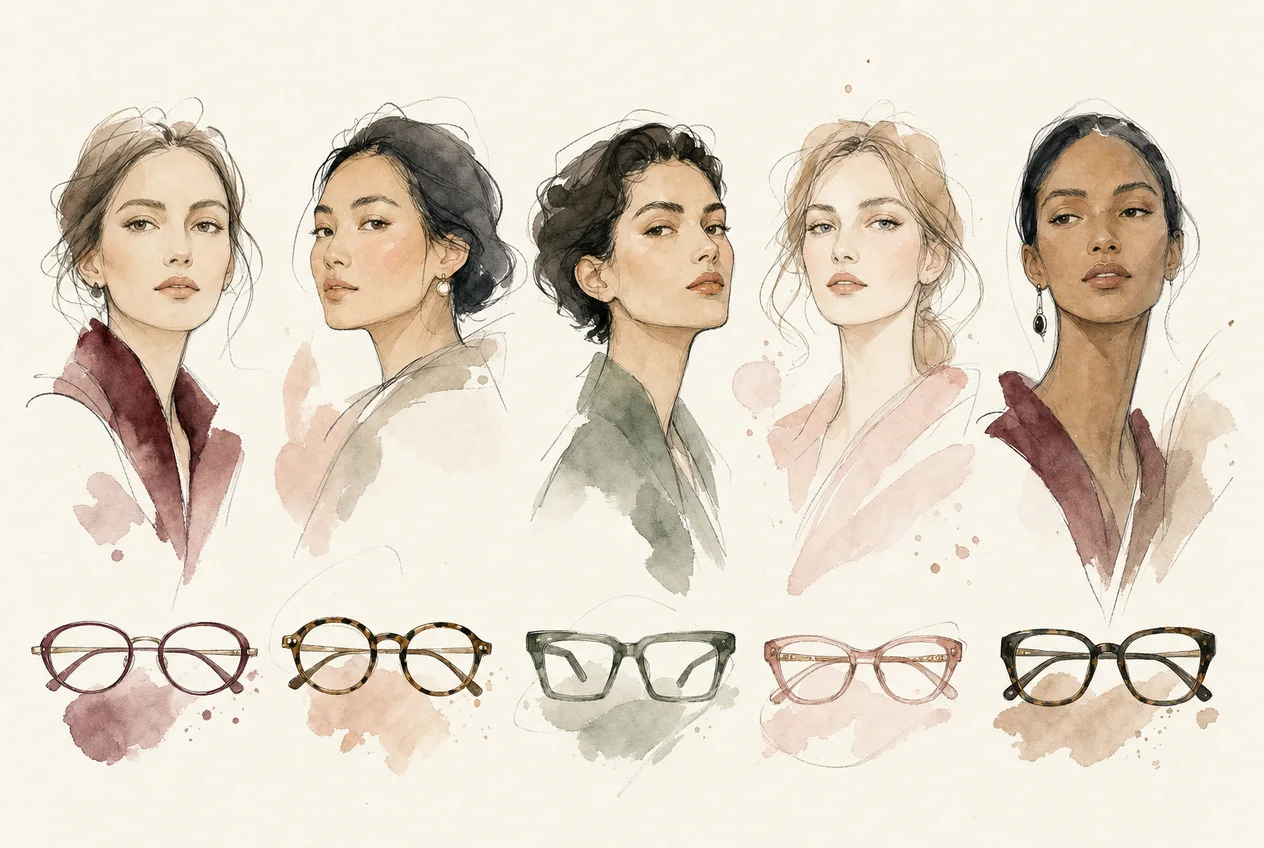
Good to know
The essentials on the method, the self-check and the most common questions.
What your face shape really tells you+
Your face shape is the outline of your face, set mostly by your bone structure: the width of your forehead, your cheekbones and your jaw, plus how long your face is compared to how wide it is. It does not change with weight the way your body does, which makes it a reliable anchor for two everyday decisions: which haircut frames you, and which glasses suit you. The guiding idea stylists have used for decades is balance. An oval is treated as the reference because its proportions are even, and for every other shape the goal is to borrow a little of that evenness. A round face wants length and angle, a square face wants softness, a long face wants width.
So the haircut and the frame are doing the same job from two directions. The hair adds or removes length and width around the face, and the glasses repeat or contrast the angles of your features. Get both pulling in the same direction and your whole face reads more balanced.
How to measure your face shape+
Pull your hair back, face a mirror straight on, and either eyeball it or use a soft tape and note four numbers.
- Forehead width across the widest part.
- Cheekbone width from the outer corner of one cheekbone to the other.
- Jaw width across the widest part of your jaw.
- Face length from your hairline straight down to the tip of your chin.
Then read the pattern. If length clearly exceeds width, you are long (oblong). If length and width are similar and the jaw is soft and rounded, you are round. If length and width are similar but the jaw is strong and angular and forehead, cheek and jaw are all close in width, you are square. If your face is a touch longer than wide with a gently rounded jaw and balanced thirds, you are oval. If your forehead and cheekbones are the widest part and your chin tapers to a point, you are heart shaped. Also look at your jawline directly: a sharp, defined jaw calls for softening, a soft jaw can carry sharper lines.
Best haircut and glasses by face shape+
| Face shape | Best haircut | Best glasses |
|---|---|---|
| Oval | Almost anything works. Keep some shape off the face so you do not hide the balance. | Most frames suit you. Keep frame width close to the widest part of your face. |
| Round | Length and volume on top, layers, side parts, long bobs. Avoid blunt chin-length cuts that echo the roundness. | Angular and rectangular frames add definition. Avoid round frames. |
| Square | Soft waves, layers, side-swept fringe to soften the jaw. Avoid heavy straight blunt lines. | Round or oval frames soften the angles. Avoid sharp square frames. |
| Heart | Chin-length and longer styles, side-swept fringe to balance the wider forehead. Avoid heavy crown volume. | Bottom-heavy or rimless frames, light cat-eye. Avoid wide, top-heavy frames. |
| Long (oblong) | Width at the sides, blunt fringe, waves and curls to shorten the face. Avoid long straight one-length styles. | Tall, deep frames with strong width break up the length. Avoid narrow frames. |
Common mistakes+
- Guessing from a bad angle. A tilted phone selfie distorts your jaw and length. Face the mirror straight on with hair back.
- Calling every strong jaw square. Square means forehead, cheek and jaw are close in width and angular. A strong jaw on a longer face is still long, not square.
- Chasing a fringe because it is trendy. A heavy blunt fringe shortens a face, which helps a long face but crowds a round one.
- Matching your features instead of balancing them. Round glasses on a round face double the roundness. You usually want gentle contrast, not a mirror.
- Treating it as fixed law. These are starting points. Hair texture, glasses size and your own taste all bend the rule.
Where the method comes from+
The face shape framework is older than any single author. It grew out of classical ideas of facial proportion, the notion of dividing the face into even thirds, that artists and portrait painters worked with for centuries, and was carried into modern beauty by mid-twentieth-century stylists, makeup artists and the optical trade. Hairdressers and optometrists adopted it because it gave a simple, repeatable way to recommend cuts and frames: classify the outline, then choose styles that move the face toward oval balance. There is no single founding study the way FFIT anchors body shape, but the oval-as-reference logic is consistent across the beauty and eyewear industries, which is why the same advice shows up almost everywhere.
FAQ
How do I find my face shape?
Look at your face length versus width, your jawline and your forehead. This guide asks four simple questions and tells you your shape.
Why does face shape matter for hair and glasses?
The right haircut and frames balance your proportions and flatter your features. We give tips per shape.
Is it free?
Yes, free and no signup.