Ring Size Calculator
Find your ring size from the inner circumference of a ring that fits, in millimetres, and see it in EU, US and UK, perfect for ordering or gifting without guessing.
Ordering a ring online, but which size am I?
Good to know
The essentials on the method, the self-check and the most common questions.
How to measure your ring size at home+
The cleanest way to find your ring size is to measure the inside circumference of a ring that already fits, in millimetres. If you do not have one, you can measure your finger directly. Both work, just measure carefully and at the right time of day.
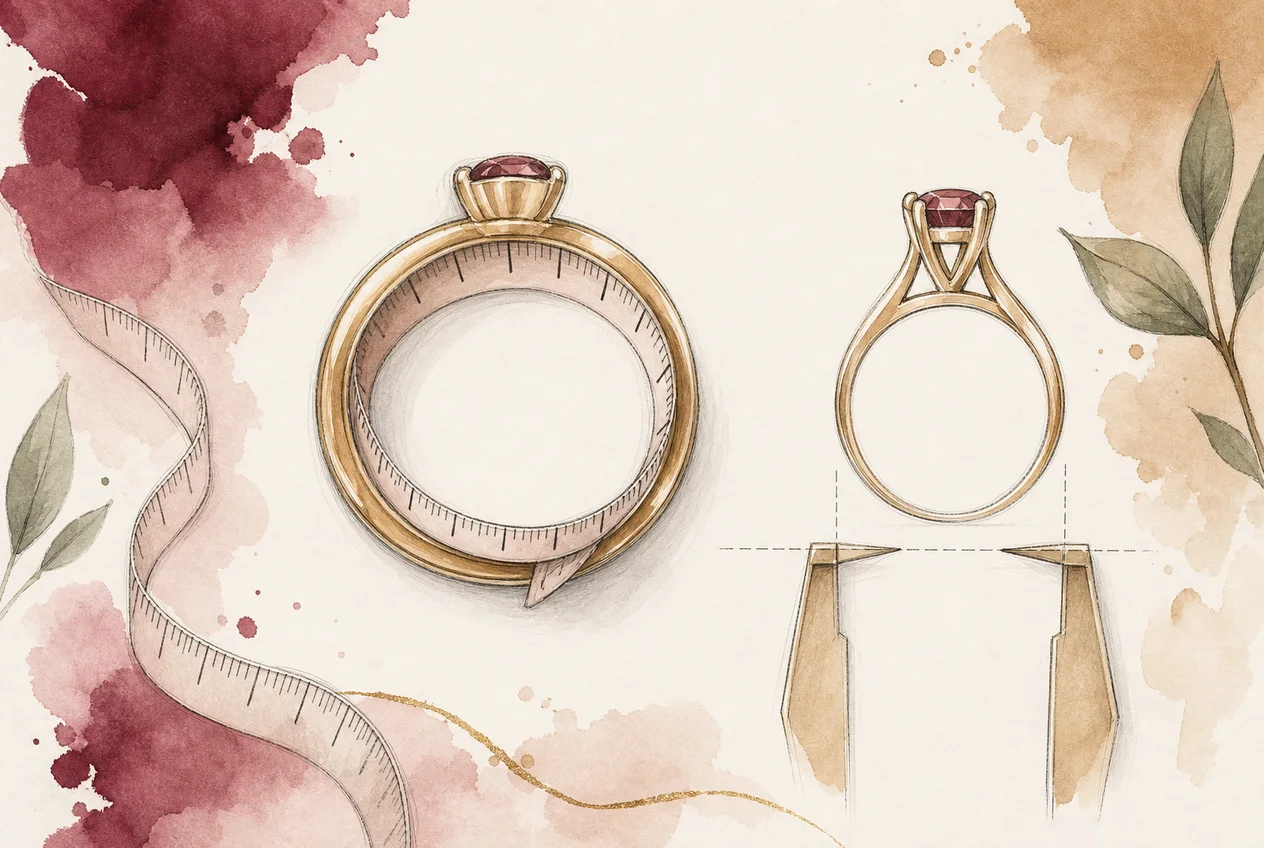
- From a ring that fits: Take a ring you wear on the right finger. Measure the inside diameter across the middle in millimetres, then multiply by 3.14 to get the circumference. Or wrap a thin strip of paper inside it and mark the inner loop.
- From your finger: Wrap a thin strip of paper or string snugly around the base of the finger, mark where it overlaps, lay it flat and read the length in millimetres. That length is your circumference.
In the German and EU system, that circumference in millimetres is your ring size directly. A 52 mm circumference is simply size 52.
Ring size conversion chart (mm, DE/EU, US, UK)+
This is the reference. The inner circumference in millimetres is the anchor, and everything else converts from it. Values are rounded, so the country systems do not always line up to a whole number.
| Circumference (mm) | Diameter (mm) | DE / EU | US | UK |
|---|---|---|---|---|
| 49.3 | 15.7 | 49 | 5 | J |
| 51.9 | 16.5 | 52 | 6 | L / M |
| 54.4 | 17.3 | 54 | 7 | N / O |
| 57.0 | 18.1 | 57 | 8 | P / Q |
| 59.5 | 18.9 | 59 | 9 | R / S |
The diameter column is handy if you only have a ruler and a single ring to measure across.
How to read the chart, with an example+
Say your strip of paper came out at 52 mm. That is your circumference, so in the German and EU system you are simply size 52. Read across the row: that lands you at a US 6 and a UK L to M.
If your number sits between two rows, round to the nearest one and lean to the larger size for a band that should slide on easily, or the smaller one for a snug fit that will not spin.
Common mistakes+
- Measuring when cold. Fingers shrink in the cold and swell in the heat. Measure at the end of a normal day, at room temperature, for a true everyday fit.
- Pulling the strip too tight. A ring has to pass over the knuckle. If the strip bites into the skin, the size will be too small.
- Forgetting the knuckle. If your knuckle is much wider than the base of the finger, measure both and choose a size in between, so the ring slides over but does not spin once on.
- Measuring the wrong finger. Even left and right hands differ. Measure the exact finger the ring is for.
A practical tip from us+
Wide bands feel tighter than thin ones, so if you are buying a chunky ring, consider going up by roughly half a size. For a surprise gift, borrow a ring she already wears on the right finger and measure its inside diameter rather than guessing. And if you land between two sizes, most jewellers can size a solid metal band up or down later, so a near-perfect fit now is easy to perfect afterward.
FAQ
How do I find my ring size?
Measure the inner circumference of a ring that fits in mm, or your finger, and the calculator converts it.
What is EU vs US ring size?
EU ring size is the circumference in mm; US and UK use their own scales. We show all three.
Is it free?
Yes, free and no signup.